Building an Online Casino Game – for Science!
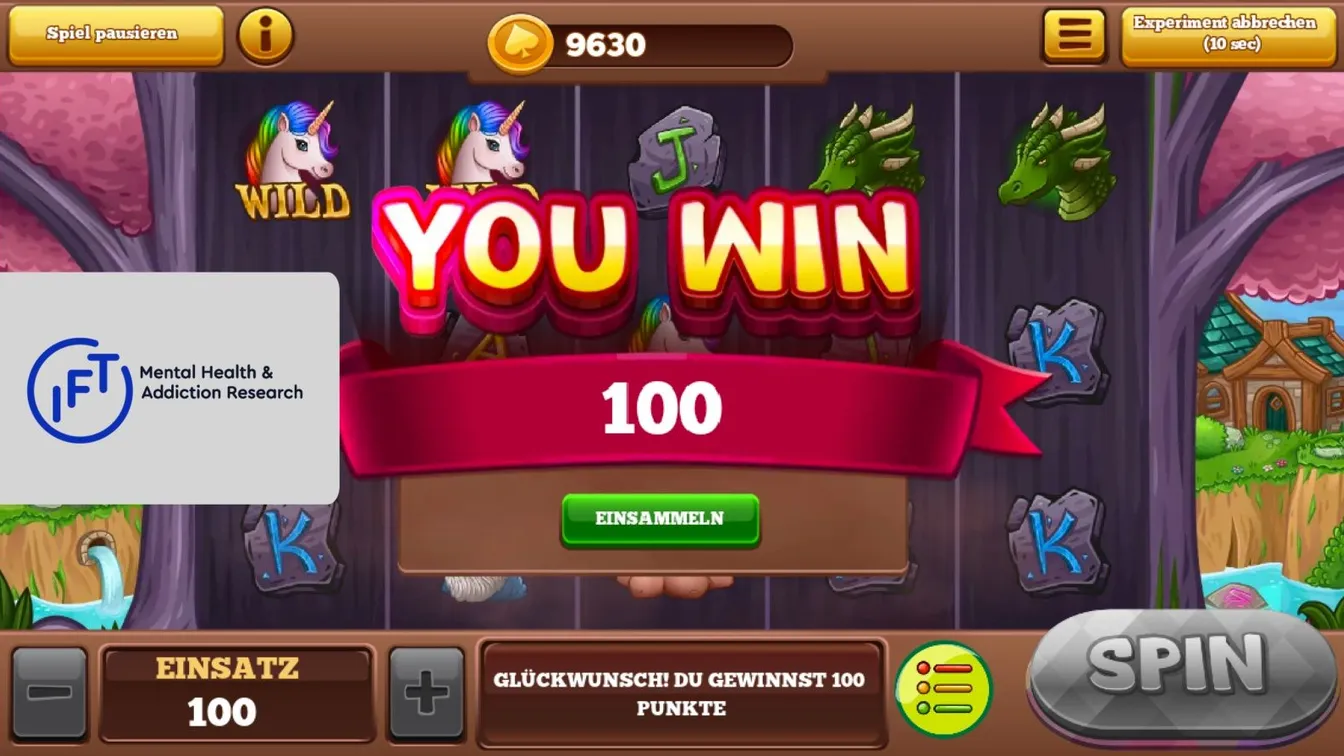
I have teamed up with a renowned German research institute to better understand gambling addiction and validate possible strategies to reduce it. The project involved building an online casino clone (in Python) with additional data collection capabilities and the development of the study’s website.
“Mr. Trippensee’s way of working was characterized by the highest degree of utmost care and outstanding commitment. Particularly noteworthy are his constructive approach at all times to changing demands on the programming content as well as his flexibility and creativity, with which he always solved arising, unforeseeable challenges quickly and in a target-oriented manner.”
— Dr. Larissa Schwarzkopf, Research Group Leader, IFT, 2021-11-30
The Research
The IFT (Institut für Therapieforschung, Munich) is one of the leading research institutes in the field of addiction disorders in Germany. Their main areas of interest are alcohol, tobacco, illicit drugs, medication, and gambling.

The experimental TESSA study (Timeout: effects on spending, stress, arousal) investigates the effect of mandatory timeouts in simulated online gaming on stakes, subjectively perceived stress, craving, and physiologically measurable arousal. In other words: do timeouts in an online casino game change the behavior of the player?
I was responsible for the planning, implementation, and development of the simulated online casino software as well as the study website. The website provides potential participants with information about the study and includes a tool for scheduling appointments. The project took approximately 3 months to plan and build. After agreeing on the scope and requirements, we decided on an agile project management approach based on Scrum in order to identify possible hidden requirements early on and to preserve flexibility.
The Features

The following features were incorporated into the final product:
- Slot machine — “online casino” type game with authentic feel
- Dynamic timeout screens — ability to generate different timeout overlays on the fly
- Data collection — gathers relevant player data (losses per round, stakes, etc.) and outputs it in a defined format
- Animations, sound, and design — a look and feel that encourages players to keep playing
- Correct, adjustable probabilities — since participants are paid real money, the probabilities are mathematically accurate and dynamically adjustable (losing over time without causing frustration)
- Dynamic questionnaires — customizable questionnaires that can be displayed at different points in the session
- Standard tooling — settings menu, seed-based randomization, introduction screens, etc.
The Implementation
I used the open source game engine Godot to accelerate development, especially to allow multi-platform exports — the game needed to run on both tablets and desktop computers.
Godot is very well documented and uses GDScript, a derivative of Python. Given my extensive experience with Python and Java, Godot was the perfect choice for this project.
As I was still studying full time, the actual implementation took about a month, during which I delivered two releases each week for review. Thanks to this close communication cadence, we made quick progress and incorporated feedback easily. Despite the tight schedule, we delivered the software on time.
Outcome
The project was a great success. First results of the TESSA study were made available in Fall of 2022. You can visit the IFT website for more information.
For ethical reasons, the source code is not public. If you are interested in the technical details, feel free to contact me.